


The New Challenge
September 15, 2026The New Challenge
September 15, 2026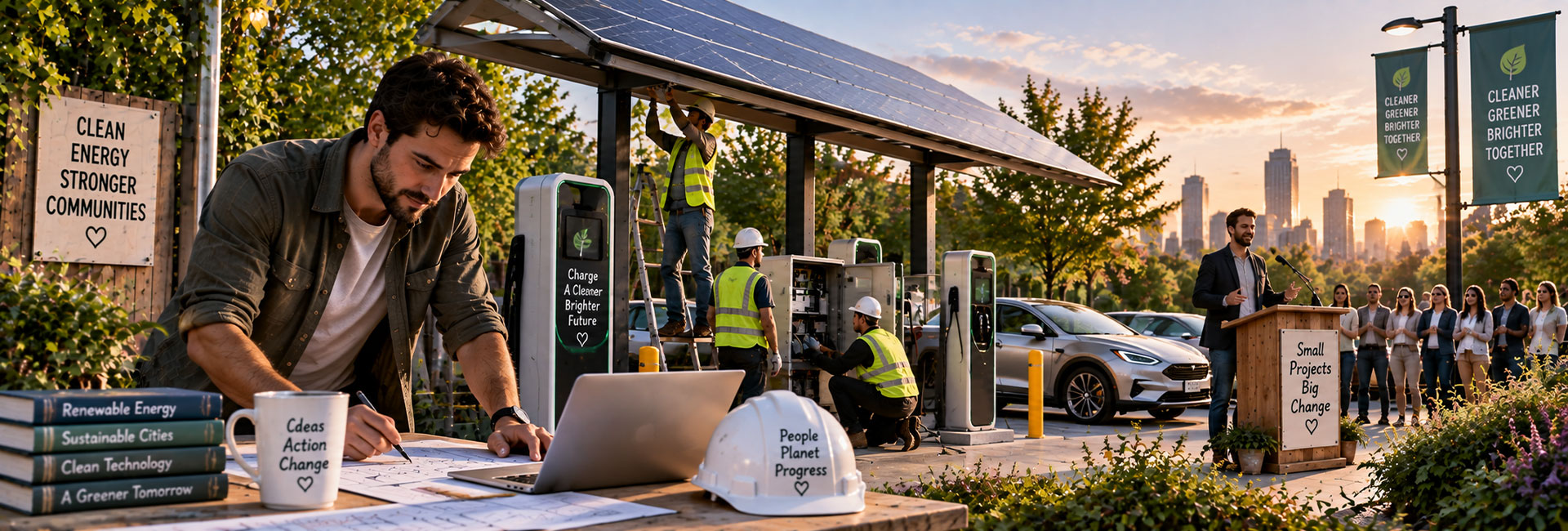
The Ambitious Project
James had always been fascinated by technology and innovation. One day, after watching a documentary on sustainable energy, he came up with an idea that was both ambitious and challenging: he would build a solar-powered charging station in his community. It wasn’t just a personal project; it was something that could make a real difference.
Before jumping into the project, James spent weeks researching how solar energy systems worked. He read articles, watched tutorials, and even joined online forums where experts discussed renewable energy. He quickly realized that while the idea was exciting, it would require precision, patience, and funding.
James knew he couldn’t do it alone, especially when it came to financing the project. He approached the local government with his idea, hoping to get their support. After a long presentation filled with diagrams and data, the officials were impressed.
“We’ll provide partial funding, but you’ll need to raise the rest,” they told him.
Determined to move forward, James launched a crowdfunding campaign. He created a compelling video explaining how the solar-powered station would benefit the community by reducing carbon emissions and providing a free, sustainable energy source for everyone. The response was overwhelming. In just a few weeks, he had raised more than enough money to begin.
With the funding in place, the next step was assembling a team of engineers, electricians, and construction workers. James reached out to professionals in his network and was able to gather a group of enthusiastic people who believed in the project as much as he did.
The construction of the station began on a sunny morning. The team worked tirelessly, installing solar panels on a metal frame, connecting cables, and setting up battery storage units. However, halfway through the process, they encountered a major problem: the batteries James had ordered weren’t powerful enough to store the energy required for the station.
Frustrated but determined, James spent days searching for a solution. He consulted with his team and eventually found a supplier who offered high-capacity batteries. The delay cost them extra time and money, but James was relieved that the project could move forward again.
Once the construction was complete, it was time to test the system. James held his breath as they flipped the switch. The solar panels absorbed the sunlight, and soon, the station was producing energy. The battery units were storing the power, and the charging ports worked perfectly.
“We did it,” one of the engineers said, smiling.
James organized a grand opening event to introduce the solar-powered station to the community. People gathered to see the new installation, and James gave a speech about the importance of sustainable energy.
“This is just the beginning,” he said. “We can all play a role in protecting our environment.”
As James looked at the station, now fully operational, he couldn’t help but think about future possibilities. He was already imagining expanding the project, creating more stations across the city. For James, the solar-powered station wasn’t just a one-time project; it was the start of something much bigger.
1 Past Perfect
The Past Perfect is used to describe an action that happened before another action or event in the past. It helps show the order in which past events happened.
Structure: Subject + had + past participle
“James had always been fascinated by technology and innovation.”
Example:
She had studied renewable energy before starting the project.
2 Would + Base Verb
“Would” is used to describe a future action or situation from a past point of view. It is especially common when talking about plans, expectations, or possibilities that existed in the past.
Structure: Subject + would + base verb
“he would build a solar-powered charging station”
Example:
James believed the project would help the community.
3 While + Clause
“While” is used to connect two situations or actions that happen during the same period. It can also introduce background information that contrasts with the main situation.
Structure: While + subject + verb, + main clause
“while the idea was exciting, it would require precision, patience, and funding.”
Example:
While the project was exciting, it required careful planning.
4 Have to + Base Verb
“Have to” expresses necessity or something that is required. In the past, it changes to “had to.” This structure is commonly used when explaining responsibilities, requirements, or unavoidable actions.
Structure: Subject + have to / has to / had to + base verb
“you’ll need to raise the rest”
Example:
James had to raise additional money to continue the project.
5 Present Perfect
The Present Perfect connects a past action or achievement to the present. It is often used when the exact past time is not important and the result or experience matters now.
Structure: Subject + have / has + past participle
“We can all play a role in protecting our environment.”
Example:
James has created a project that benefits his community.
| # | Word / Phrase | Meaning in English |
|---|---|---|
| 1 | Fascinated | Extremely interested in something. |
| 2 | Innovation | A new idea, method, or technology that improves something. |
| 3 | Ambitious | Involving a strong desire to achieve something difficult or impressive. |
| 4 | Sustainable energy | Energy produced from sources that can be used without permanently harming the environment. |
| 5 | Renewable energy | Energy that comes from natural sources that are continuously replenished. |
| 6 | Precision | Great accuracy and careful attention to detail. |
| 7 | Funding | Money provided for a particular project, activity, or purpose. |
| 8 | Approach | To go to someone or contact them in order to ask for help, information, or support. |
| 9 | Partial funding | Financial support that covers only part of the total cost. |
| 10 | Raise money | To collect money for a particular purpose. |
| 11 | Crowdfunding campaign | An organized effort to collect small amounts of money from many people, usually online. |
| 12 | Compelling | Very convincing or interesting and able to attract attention. |
| 13 | Carbon emissions | Carbon-containing gases released into the atmosphere, especially from human activities. |
| 14 | Assemble | To bring people or parts together to form a group or complete something. |
| 15 | Tirelessly | With great effort and without becoming tired or stopping. |
| 16 | Encounter | To experience or face a problem, difficulty, or situation. |
| 17 | High-capacity | Able to hold, store, or handle a large amount of something. |
| 18 | Relieved | Feeling relaxed or happy because a difficult or worrying situation has ended successfully. |
| 19 | Operational | Working correctly and ready to be used. |
| 20 | Possibilities | Things that may happen or be possible in the future. |
- Why did James decide to build a solar-powered charging station, and what did he hope it would achieve?
- What problems did James face during the project, and how did he find solutions to them?
- What do you think James might do next after successfully completing the charging station?



Learn English Through Short Stories
Improve your English naturally with engaging English stories designed for language learners. Read stories in English, build your vocabulary, learn useful English grammar in context, and improve your reading and listening comprehension through stories.