


Mia and Her Baby Brother
September 18, 2026
Ser Alaric and Dracorith
September 18, 2026Mia and Her Baby Brother
September 18, 2026Ser Alaric and Dracorith
September 18, 2026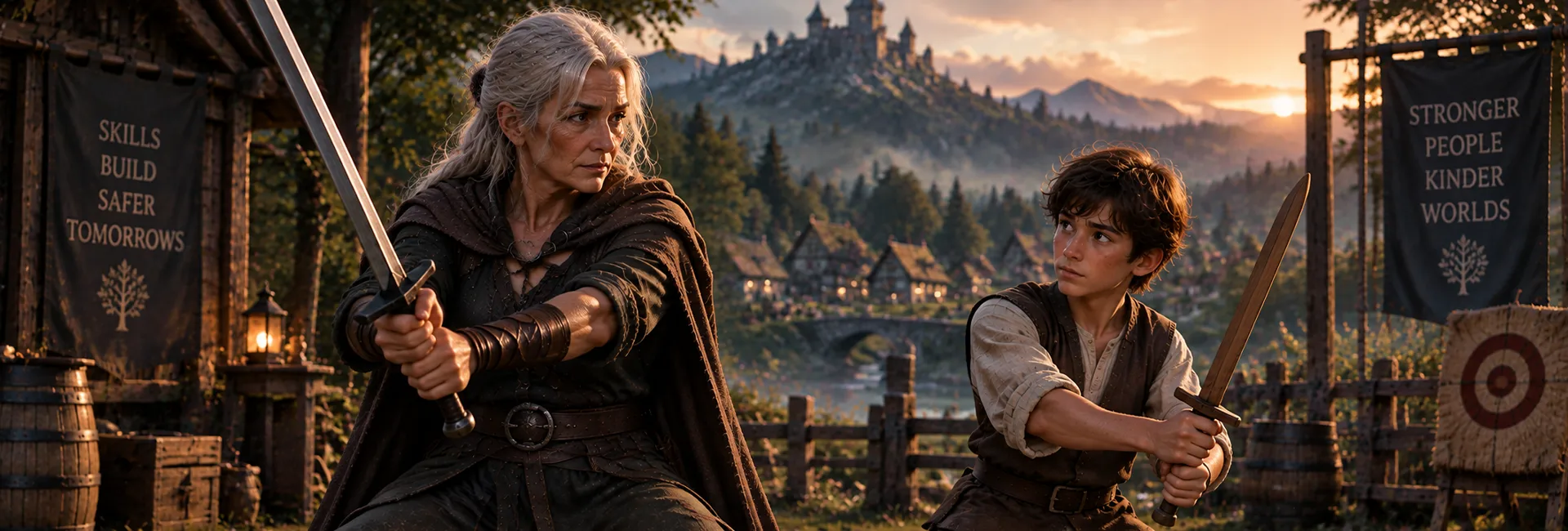
The Legend of Eira
In a land long forgotten by many, there was a dense forest where few dared to go. Deep within its heart, there lived a woman known only as Eira. She was once a famous warrior, a master of the sword. Now, she lived alone, surrounded by nature, far from the chaos of the world she left behind.
Eira’s name was known across kingdoms. She had fought in many battles and was said to be undefeatable with a sword in her hand. Stories of her bravery spread far and wide, but after the last great war, she disappeared, leaving behind only tales and rumors.
Eira had chosen this quiet life. She spent her days practicing her swordsmanship, tending to her small garden, and watching the seasons change. Though she was at peace, her heart still carried the weight of her past battles and the lives she had taken.
One cold evening, as Eira sharpened her sword by the fire, there was a knock on her door. She hadn’t had visitors in years. When she opened the door, a young man, barely a warrior, stood before her, his eyes full of desperation.
“Are you Eira, the sword master?” he asked.
The young man introduced himself as Leif. His village was under attack by bandits, and they had no one to protect them. He had heard of Eira’s skill and begged her to come help. “I’m no hero,” she said, but Leif refused to leave without her.
Reluctantly, Eira agreed to go with Leif. She hadn’t drawn her sword for anyone but herself in years. As they journeyed through the forest, she felt the old fire in her blood returning, though she tried to push it down.
“I am no longer the woman I once was,” she thought.
When they reached the village, it was worse than Leif had described. The bandits had already taken much from the villagers, and there was little left. That night, the bandits returned, and for the first time in years, Eira stepped into battle. Her sword moved with the same deadly grace as before, cutting through the chaos.
The battle was long and bloody, but with Eira leading the defense, the villagers fought back. The bandits, who had been terrorizing the village for months, were unprepared for the skill of the old warrior. By dawn, the village was safe, and the bandits had fled.
After the battle, the villagers gathered to thank Eira. They called her a hero, but Eira only felt tired. The years of fighting had left her weary, and though she had saved the village, the weight of the lives she had taken once again hung over her.
Leif, inspired by Eira’s bravery, asked her to stay and teach him the ways of the sword. At first, Eira refused, but Leif was persistent.
“You have more to teach than just fighting,” he said.
Slowly, Eira began to see that perhaps she could pass on her knowledge to the next generation.
Days turned into weeks, and Eira began training Leif. He was eager to learn, but his lack of experience showed in every swing. Eira was patient, guiding him through each mistake, reminding him that the sword was not just a weapon, but an extension of oneself.
As she trained Leif, Eira found herself remembering her own training, long ago. She had been young, like him, full of dreams and hope. But the wars had changed her, made her cold and distant. Now, teaching Leif, she saw a chance to change her own path.
One morning, as Eira and Leif trained, a rider came to the village with news. The bandits had regrouped and were seeking revenge. Worse, they were being led by someone from Eira’s past, a rival warrior who had fought beside her in the old wars. His name was Bjorne.
Bjorne had always been jealous of Eira’s skill. During the wars, he had tried to defeat her many times, but had always failed. Now, he had returned, seeking to finally best her. “He won’t stop until he fights you,” Leif said. Eira knew this was true.
Eira and Leif spent days preparing the village for the attack. Eira’s old instincts returned as she trained the villagers and fortified their defenses. But she knew that no matter how strong their defense, the real battle would be between her and Bjorne.
The day of the battle came. Bjorne and his bandits stormed the village, but the villagers were ready. Eira stood at the center of the village, waiting for Bjorne. When he arrived, he challenged her to a duel, just as she knew he would.
“This ends today,” he said.
The duel was fierce. Bjorne was stronger, but Eira was faster, her movements precise and deadly. The two warriors clashed, their swords ringing through the air. For a moment, it seemed like Bjorne might overpower her, but Eira’s years of experience gave her the edge.
With one swift movement, Eira disarmed Bjorne, sending his sword flying. He fell to the ground, defeated. But instead of delivering the final blow, Eira lowered her sword.
“It’s over,” she said. “I’m not the same person I was before.”
Bjorne, realizing his defeat, fled.
The village celebrated their victory, but Eira felt no joy in the violence. She knew now that her days of fighting were over. She had protected the village, but she had also found a new purpose in teaching Leif and helping the villagers defend themselves.
Eira stayed in the village, not as a warrior, but as a teacher. She trained Leif to be a master of the sword, and together they trained others. The village became known for its skilled fighters, but Eira knew that her true victory was not in battle, but in passing on her knowledge to the next generation.
1 Past Perfect
The Past Perfect is used to describe an action or situation that happened before another event in the past. It helps make the sequence of past events clear.
Structure: Subject + had + past participle
“She hadn’t had visitors in years.”
Example:
Eira had lived alone for many years before Leif found her.
2 Used To + Base Verb
“Used to” describes a past habit or situation that was true in the past but is no longer true.
Structure: Subject + used to + base verb
“She was once a famous warrior.”
Example:
Eira used to fight in many battles before she left the warrior's life.
3 Though + Clause
“Though” introduces a contrast between two ideas. It shows that one fact is true despite another fact or situation.
Structure: Though + subject + verb, + main clause
“Though she was at peace, her heart still carried the weight of her past battles.”
Example:
Though Eira was tired, she continued to help the villagers.
4 While + Clause
“While” can connect two actions or situations happening during the same period. It can also introduce a background action.
Structure: While + subject + verb, + main clause
“While she tried to push it down, she felt the old fire in her blood returning.”
Example:
While Eira trained Leif, she remembered her own childhood.
5 Instead Of + Gerund
“Instead of” is used to show that one action or choice happens in place of another. When followed by a verb, the verb takes the -ing form.
Structure: Instead of + verb-ing
“But instead of delivering the final blow, Eira lowered her sword.”
Example:
Instead of fighting Bjorne, Eira chose to teach the next generation.
| # | Word / Phrase | Meaning in English |
|---|---|---|
| 1 | Long forgotten | Not remembered or thought about for a very long time. |
| 2 | Dense forest | A forest with many trees growing close together. |
| 3 | Warrior | A person who fights in battles, especially in the past. |
| 4 | Swordsmanship | The skill of fighting with a sword. |
| 5 | Tend to | To take care of or look after someone or something. |
| 6 | Chaos | A situation with a lot of confusion, disorder, or lack of control. |
| 7 | Desperation | A strong feeling of needing or wanting something because a situation is very difficult. |
| 8 | Bandits | People who attack or rob others, especially while traveling or living in remote areas. |
| 9 | Reluctantly | In a way that shows you do not really want to do something. |
| 10 | Journey | The act of traveling from one place to another. |
| 11 | Villagers | People who live in a village. |
| 12 | Weary | Very tired, especially after a long period of effort or difficulty. |
| 13 | Pass on | To give knowledge, skills, or information to another person. |
| 14 | Persistent | Continuing to try despite difficulties or rejection. |
| 15 | Extension of oneself | Something that feels like a natural part of a person's identity or abilities. |
| 16 | Regroup | To come together again and prepare for another attempt or action. |
| 17 | Fortify | To make a place stronger and better protected against attack. |
| 18 | Overpower | To defeat someone by being stronger or more powerful. |
| 19 | Disarm | To take a weapon away from someone. |
| 20 | Next generation | The group of people who will live or work after the current generation. |
1. Why do you think Eira chose to leave her life as a warrior?
2. How did teaching Leif change Eira’s view of her past?
3. What can people learn from Eira’s decision to pass her knowledge to the next generation?



Learn English Through Short Stories
Improve your English naturally with engaging English stories designed for language learners. Read stories in English, build your vocabulary, learn useful English grammar in context, and improve your reading and listening comprehension through stories.